3.7cm Pak 35/36 anti-tank gun & variants
Official wording
German, cal. 37 mm Rheinmetall Borsig anti-tank guns mfd. prior to 1946, including the following variations or designations: German issue 3.7cm PAK 35, PAK 35/36, PAK 36, Swedish 3.7cm PvKan m/38, Italian 37mm Cannone contracarro da 37/45 (captured designation 3.7cm PAK 162(i)), Russian 37mm Protivotankovaya Pushka obrets 1930 (captured designation 3.7cm PAK 158(r)), Dutch 37mm Rheinmetall (captured designation 3.7cm PAK 153(h)), and Japanese 37mm Type 97 (PAK36 purchased by Japan).
What this entry requires
- ATF REQUIRESMade 1945 or earlier (ATF’s dates)ATF: “mfd. prior to 1946”
- INFOStill an NFA firearm; only registered examples transfer, with ATF approval (26 U.S.C. 5812, 5861).
Editorial facts · Our research

Source
- Official wording
- ATF P 5300.11, April 2025 edition · Section IV · PDF p. 84 ↗ · ATF original ↗
- Entries
- 1 line
- Verbatim check
- Checked against the PDF text before every release
- Editorial facts
- Confidence: High · Last revised 18 October 2026 (Evidence pass) · How we rate confidence
- References
- 1. Wikipedia, “3.7 cm Pak 36” ↗, maker: Rheinmetall design; the Soviet 37 mm M1930 (1-K) and the Japanese Type 97 were 'designed by Rheinmetall and produced under license'
- 2. Wikipedia, “3.7 cm Pak 36” ↗, action: towed anti-tank gun (an artillery piece, no small-arms action): Other
- 3. Wikipedia, “3.7 cm Pak 36” ↗, years: Rheinmetall's 3.7 cm Pak L/45: 'the first guns were issued in 1928'; Pak 35/36 from 1934; German production ceased early 1943; end limit is ATF's 'mfd. prior to 1946'
- Fact tags
- ATF the ATF wording states it.
- REF ¹ an outside reference supports it; the number points to the list of references.
- ESTIMATE an approximate or indirect reading, for example the production range of the base model.
- NO CITATION we haven’t attached a reference for this fact; it’s our editorial reading, not ATF’s.
- Source checked
- 20 October 2026: ATF’s page still lists the April 2025 edition
- Corrections
- None
Historical context
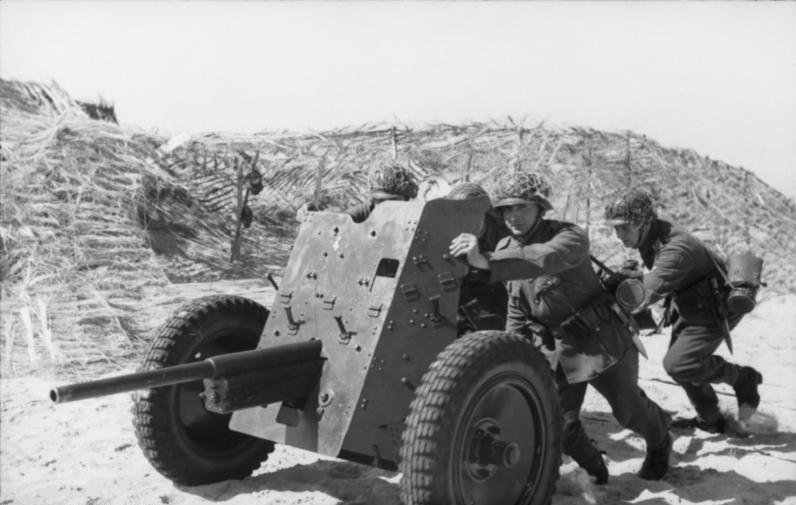
Image: Wikimedia Commons, “Bundesarchiv Bild 101I-299-1831-26, Nordfrankreich, Soldaten mit Geschütz.jpg” by Johannes Hähle, CC BY-SA 3.0 de. Retrieved October 2026.
Summary: Wikipedia, “3.7 cm Pak 36”. Text CC BY-SA 4.0.
FROM WIKIPEDIA
The Pak 36 is a 3.7 cm / 37mm caliber German anti-tank gun used during the Second World War. It was the main anti-tank weapon of Wehrmacht Panzerjäger units until 1942. Developed by Rheinmetall in 1933, it was first issued to the German Army in 1936, with 9,120 being available by the beginning of the war in September 1939 and a further 5,339 produced during the war. As the predominant anti-tank gun design in the world during the late 1930s, demand was high for the Pak 36, with another 6,000 examples produced for export and the design being copied by the Soviet Union as the 45 mm anti-tank gun M1932 (19-K) and by other nations such as Japan.