C&R · IV · 154
Type 97 20mm anti-tank rifle
Section IV: still an NFA firearm, also a curio or relic
Official wording
ATF P 5300.11 · APRIL 2025 EDITION · SECTION IV · VERBATIM · PDF P. 86 ↗
Japanese, Type 97 (1937), 20mm Anti-Tank machinegun.
What this entry requires
- INFOATF states no date; production was about 1938–1943.
- INFOStill an NFA firearm; only registered examples transfer, with ATF approval (26 U.S.C. 5812, 5861).
Editorial facts · Our research
- Country
 JapanBasis: the ATF wording
- Manufacturer
- Kokura Army Arsenal; Nihon TokushukōBasis: outside reference ¹
- Type
- MachinegunBasis: the ATF wording
- Action
- Semi-auto / Select-fire / autoBasis: outside reference ³
- Caliber
- 20mmBasis: the ATF wording
- Made
- 1938–1943production; ATF states no dateBasis: outside reference ²
- Service
- Military
Source
- Official wording
- ATF P 5300.11, April 2025 edition · Section IV · PDF p. 86 ↗ · ATF original ↗
- Entries
- 1 line
- Verbatim check
- Checked against the PDF text before every release
- Editorial facts
- Confidence: Medium · Last revised 18 October 2026 (Evidence pass) · How we rate confidence
- References
- 1. Wikipedia, “九七式自動砲” ↗, maker: production began at the Kokura Army Arsenal in 1938; about 100 more made January–August 1943 by Nihon Tokushukō (en infobox manufacturer Kokura Arsenal)
- 2. Wikipedia, “九七式自動砲” ↗, years: FY1938 50, FY1939 250, FY1940 450, 1941 300 (to December), then stopped; ~100 in January–August 1943; en infobox production date 1939–1943; y covers both
- 3. Wikipedia, “Type 97 automatic cannon” ↗, action: infobox action gas-operated, open bolt, semi-automatic; body: "Despite reports that it can fire in full-automatic mode [Zaloga; US Handbook], the weapon is semi-automatic only as it lacks a selector" (Williams; 1943 operations manual). Sources disagree and ATF calls it a machinegun, so both actions are kept, Semi-auto first
- Fact tags
- ATF the ATF wording states it.
- REF ¹ an outside reference supports it; the number points to the list of references.
- ESTIMATE an approximate or indirect reading, for example the production range of the base model.
- NO CITATION we haven’t attached a reference for this fact; it’s our editorial reading, not ATF’s.
- Source checked
- 20 October 2026: ATF’s page still lists the April 2025 edition
- Corrections
- 3 changes · see below
Correction history
- Evidence passYears: 1937–1945 → 1938–1943. Japanese Wikipedia (九七式自動砲), en infobox 1939–1943
- Evidence passAction: Select-fire / auto → Semi-auto, Select-fire / auto. Wikipedia Type 97 automatic cannon: semi-automatic only per Williams and the 1943 operations manual, full-auto per Zaloga and the US Handbook; ATF's "machinegun" keeps Select-fire / auto
- Evidence passMaker: Japanese Army arsenals → Kokura Army Arsenal; Nihon Tokushukō. Japanese Wikipedia (九七式自動砲), en infobox 1939–1943
Historical context
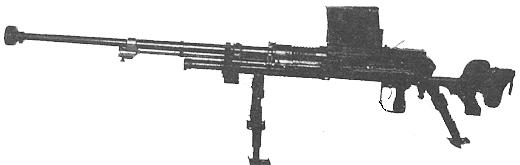
Image: Wikimedia Commons, “AT rifle Type 97 1.JPG”, Public domain. Retrieved October 2026.
Summary: Wikipedia, “Type 97 automatic cannon”. Text CC BY-SA 4.0.
FROM WIKIPEDIA
The Type 97 automatic cannon is a 20-millimeter (0.8 in) Japanese anti-tank rifle that began development in the 1930s. It was used by the Imperial Japanese Army (IJA) during the Second Sino-Japanese War, the Soviet–Japanese border conflicts and the Pacific War. Improvements in armour thicknesses on tanks rendered the Type 97 obsolete by about 1942. This weapon was not related to the Type 97 heavy tank machine gun used in armored vehicles or the Type 97 aircraft machine gun used in Japanese Navy aircraft.